
GEOFFREY SQUIRE BURSARY...
|
Thanks to a generous legacy to the Costume and Textile Association from the estate of the late Geoffrey Squire (1924 -2011), a well-known costume and textile historian and theatre designer, the C&TA has set up an award programme of bursaries in his memory.
In keeping with his career and lifelong interests, the bursary is awarded to support research work and study in the field of textiles or costume. These biennial awards of up to £2000 are awarded for research which can be spread over two years. They have already contributed materially to costume and textile research and practical applications, covering Anglo-Saxon embroidery, local medieval worsted spinning, 18th century textile manufacturing methods in Norwich and its trade internationally, and most recently, zines on radical quilt history. The fourth round of awards was made in June 2023. Jenny Daniels - Geoffrey Squire Memorial Bursary coordinator mailto:mjandjmdaniels@gmail.com 2023 Bursary Award Winner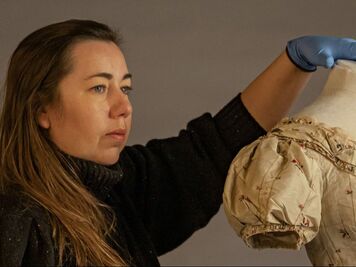
Anna Deacon was awarded £2000 to support her research project Hidden in the Archives: Heirloom Textiles of Tamaki Paenga Hira Auckland War Memorial Museum. This was the unanimous recommendation of the independent Selection Panel for the award. Anna is now based in Auckland, New Zealand, after a career in UK and is currently studying for an MA in Historical Costume at the University of Bournemouth. Her project funded by the bursary will study in depth Eurocentric garments from the 18th and early 19th centuries which are held in the Auckland War Memorial Museum, and bring them to a wider public. This she intends to achieve by researching contemporary construction methods in order to make precise garment textile re-creations, and also discovering the “back stories” of the garments through engaging with Auckland family heritage groups. She plans as well to devise an easily-accessible pattern-drafting system similar to that of Janet Arnold in her Patterns of Fashion series. This would be for use by the wider interested public, and she intends to publish her findings in text, talks and online. 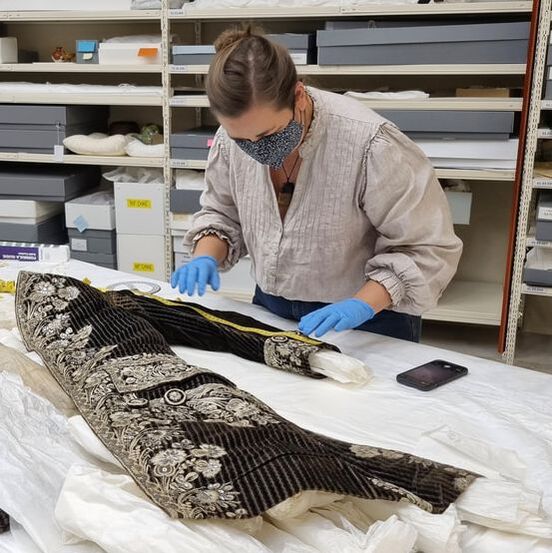
Anna Deacon with textile from Aukland War Memorial Museum
2021 Bursary Award winner
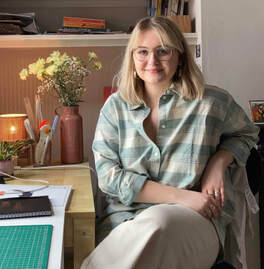
The third Geoffrey Squire Memorial Bursary winner wasoLaura Moseley (right) to support her project proposal to create and publish Stories in Cloth: Two Zines on Radical Textile History.
Laura's application was the unanimous choice of the independent selection panel who were impressed by her clear and professional proposal. The first zine Many Hands Make a Quilt – Short Histories of Radical Quilting (written with Jess Bailey of UC Berkeley) explores Norwich's textile heritage of 19th and 20th century quilts calling for criminal justice reform. Her second zine, Diasporic Threads: Black Women, Fibre and Textiles (written with Dr Sharbreon Plummer of Ohio State University), will highlight black women's contribution to art and history through textiles and will be based on research into intersections of race, art and cultural memory. This collaborative project, to be published by Laura through Common Threads Press, is likely to create a young and new audience for historical and contemporary textiles in a fresh, exciting and affordable format as zines.
The second award of £1,000 went to Jennifer Monahan's proposal Spinning a Yarn: The women spinners of Norfolk's medieval textile industry. Her aim is to research the roles of these unsung heroines of Norfolk's famous worsted industry, women whose continuous production of finely-spun yarn was essential for the weavers but remains largely unrecognised. She also plans an in-depth study of the local industry, weaving using authentic techniques, setting -up an online blog and involving colleagues in practical archaeology.
|
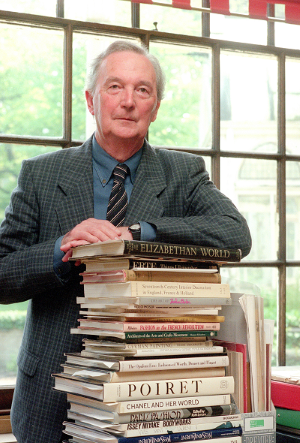
About Geoffrey Squire
Geoffrey Squire (1924-2011) retired to Norfolk after a long and varied career in London as a designer, educator, historian, author and scholar. Theatre design, and the history of fine and applied arts, especially textiles and costumes, were his passions, and he was one of the founder members of the Costume Society and an early vice-president. In Norwich he met fellow textile and costume historians Pamela Clabburn and Helen Hoyte, both of whom very involved with the Costume and Textile Study Centre (CTSC) and with C&TA. Geoffrey became a valued volunteer at CTSC and a regular and popular lecturer there. He also contributed a series of lively and erudite articles for the C&TA Newsletter (the fore-runner of Miscellany). His writing was both informed and perceptive, and his book Dress, Art and Society (Studio Vista, 1971), now out of print, remains to this day on the V&A reading list. A review of his unpublished manuscript Masculine Habits, 1850-1970 appears in the 2015 issue of Miscellany. Following his death in 2011, the C&TA received an astonishingly generous legacy. In 2014, C&TA used £3,000 of our legacy to underwrite the very successful Geoffrey Squire Memorial Competition exhibition 'Silvery Threads' and a biennial bursary in his name was launched in 2017 to support and encourage research and study in the fields of costume and textiles. Geoffrey Squire lies at rest in a quiet Norfolk churchyard. We will continue to honour with gratitude the memory of this remarkable and generous benefactor. |
|
Inaugural award winners, 2017
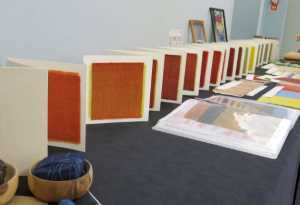
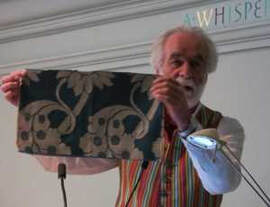
In 2017 the inaugural award went jointly to Aviva Leigh and Dr. Michael Nix, pictured at the presentation of their research in October 2018. Michael Nix's research related to the export of Norwich textiles in the 1700s when the industry was at its most successful, and involved travel to Paris to study the Moccafy manuscripts held at the Bibliothèque Forney. Gian Batta Moccafy was a Piedmontese merchant who toured Europe to visit textile manufacturers and collect patterns with a view to recreate them in Piedmont. Dr Nix's research has given us a greater knowledge of Norwich's global trade in textiles in the 18th century In 2023, with the help of the bursary, he published a comprehensive history of Norwich Textiles: Norwich Textiles: Global Story, 1750-1830. Aviva Leigh and Michael Nix worked together on a technical analysis of the fabric swatches in the early Norwich Pattern Books and Aviva reconstructed several examples of the patterns, weaving sufficient cloth to make a gentleman's waistcoat (worn here by Michael, pictured with Aviva). This gives us a greater understanding of the methods used to create 'Norwich Stuffs” and a sense of how the pieces would have appeared and felt. View Aviva's presentation on her website |
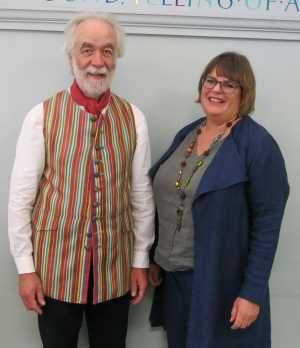
Dr Michael Nix and Aviva Leigh
|